





Your Microsoft SQL Server bill on AWS consists mainly of licenses, not computing power.
On an R8a.8xlarge instance with the Enterprise edition, the license alone accounts for over 90% of the annual cost, making the database server the most important cost driver at your disposal.
AMD EPYC M8a and R8a instances on Amazon RDS
Amazon RDS Now Supports Microsoft SQL Server on M8a and R8a instances powered by 5th-generation AMD EPYC “Turin” processors, featuring the AWS-exclusive EPYC 9R45 chip.
M8a instances are general-purpose instances, and R8a instances are memory-optimized instances.
One key feature is crucial for databases: each vCPU on these instances is a full physical core, not a hyperthreading thread. Since SQL Server is licensed per vCPU, each licensed core delivers the performance of a full physical core.
AMD EPYC Performance for Microsoft SQL Server
Higher performance per core directly translates to fewer licensed cores.
An R8a instance with optimized memory achieves the following results in an SQL Server OLTP workload (derivative test TPC-E) compared to the corresponding Intel R8i instance:
- R8a.xlarge: 1.63x the OLTP throughput of R8i.xlarge, or 63% more,
- R8a.2xlarge: 1.54x the bandwidth,
- R8a.4xlarge: 1.35x the bandwidth.
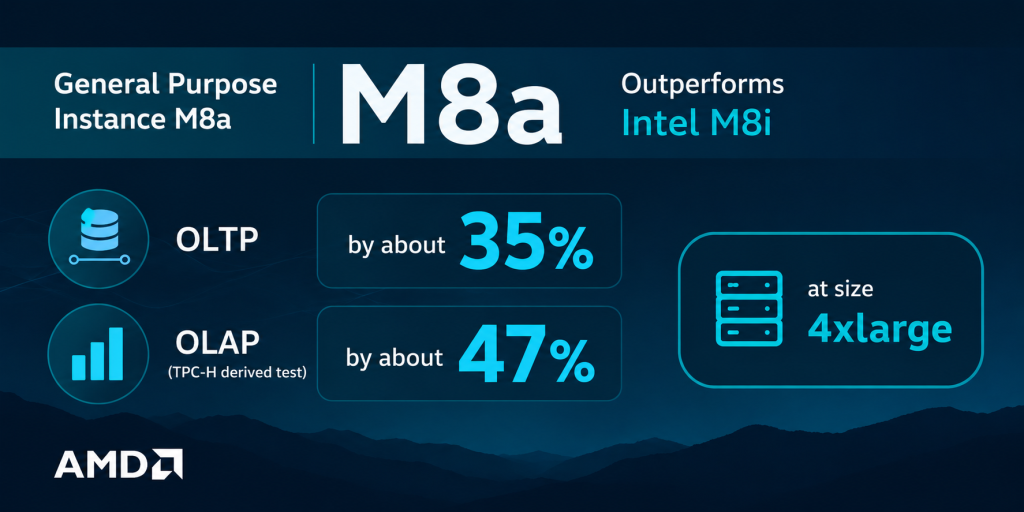
The M8a general-purpose instance outperforms the Intel M8i by approximately 35% in OLTP and by approximately 47% in OLAP (derivative test TPC-H) at the 4xlarge size.)
Cost of a Microsoft SQL Server license on AWS
Higher throughput per core means that the same workload can be accommodated by fewer licensed cores. This directly affects the cost:
- With the R8a license included, it achieves a transaction cost that is up to 36% lower than that of the R8i,
- excluding the license, it remains about 29% lower, which confirms that the profit stems from computational efficiency rather than from the license billing itself.
Power consumption of AMD EPYC instances on Amazon RDS
AMD instances consume about half the power of comparable Intel components. An M8a instance consumes up to 320W, compared to about 600W for the equivalent Intel instance.
Migrating Microsoft SQL Server to Amazon RDS Without Changes to the Application
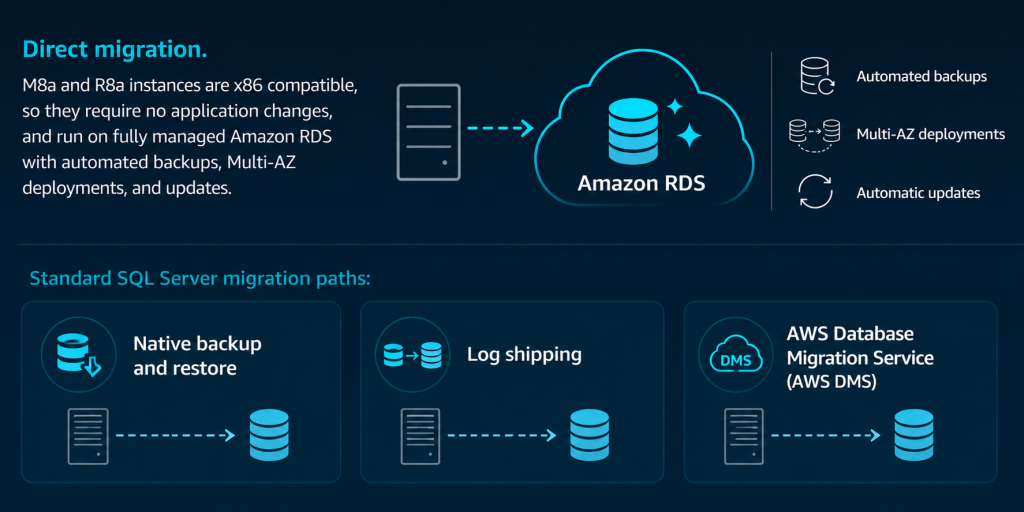
Migration is straightforward. M8a and R8a instances are x86-compatible, so they require no changes to your application, and they run on fully managed Amazon RDS with automatic backups, Multi-AZ deployments, and updates. The standard SQL Server migration paths apply:
- native backup and restore,
- log shipping,
- AWS Database Migration Service (AWS DMS).
Amazon RDS Optimize CPU for SQL Server
Amazon RDS Optimize CPU allows you to reduce the number of billed and licensed vCPUs while retaining the full instance memory, so that licensing follows the workload rather than the instance size. A safe first step when moving away from x86 processors with hyperthreading is to halve the number of allocated vCPUs, since the performance headroom per AMD core covers the marginal hyperthreading thread.
Reduce the cost of Microsoft SQL Server licenses on Amazon RDS
Microsoft SQL Server on Amazon RDS with AMD EPYC M8a and R8a instances is available now. Price the same workload on R8a and compare the cost per transaction. For more information, visit AMD and AWS.
Frequently Asked Questions
Microsoft SQL Server on Amazon RDS with AMD EPYC processors — performance, costs, and migration.
What are the AMD EPYC M8a and R8a instances on Amazon RDS?
These are Amazon RDS instance classes for Microsoft SQL Server built on 5th-generation AMD EPYC “Turin” processors featuring the EPYC 9R45 chip, which is exclusive to AWS. M8a instances are general-purpose instances, while R8a instances are memory-optimized instances. Each vCPU is a full physical core, not a hyperthreading thread.
Why does the number of cores affect the cost of SQL Server?
Microsoft SQL Server is licensed per core, and on an R8a.8xlarge instance running the Enterprise edition, the license alone accounts for over 90% of the annual cost. Higher performance per core means that the same workload can be accommodated by fewer licensed cores, which reduces licensing costs.
What is the performance advantage of AMD EPYC over Intel for SQL Server?
In an OLTP SQL Server workload (TPC-E-derived test), the R8a instance outperforms the Intel R8i:
- R8a.xlarge: 1.63x the bandwidth, or 63% more,
- R8a.2xlarge: 1.54x the bandwidth,
- R8a.4xlarge: 1.35x the bandwidth.
The M8a instance outperforms the Intel M8i by approximately 35% in OLTP and approximately 47% in OLAP (TPC-H-derived test) at the 4xlarge size.
By how much does AMD EPYC reduce the cost of SQL Server on Amazon RDS?
With the license included, the R8a achieves a transaction cost that is up to 36% lower than that of the Intel R8i. With the license excluded, it remains about 29% lower, which shows that the benefit stems from computational efficiency rather than the license billing itself. AMD instances also consume about half the power of comparable Intel instances—up to 320W versus about 600W.
Does migrating SQL Server to AMD instances require changes to the application?
No. M8a and R8a instances are x86-compatible, so migration does not require any changes to the application. The standard migration paths apply: native backup and restore, log shipping, or AWS Database Migration Service (AWS DMS), to a fully managed Amazon RDS instance with automatic backups, Multi-AZ deployments, and updates.
What are the benefits of Amazon RDS Optimize CPU?
Amazon RDS Optimize CPU reduces the number of billed and licensed vCPUs while maintaining the instance’s full memory. This ensures that licensing aligns with actual workload rather than instance size. When moving away from x86 processors with safe hyperthreading, the first step is to halve the number of allocated vCPUs, since the performance headroom per AMD core covers the marginal hyperthreading thread.
Schedule a free consultation and discover the possibilities of the cloud
We're glad you're interested in learning more about RDS. Please contact our specialists for more information.